You’re Not Wrong. The Ground Moved.
Why principled entrepreneurs with real results are losing ground — and why doing everything right stopped working.
By Immy JayI. The Pain
You’re not new at business. You’ve been doing it for years. You have real results, real clients, real evidence that your work changes things. And you’ve built and grown this business deliberately, from nothing.
And yet.
The calls aren’t booking the way they used to. The content that once moved people now gets polite silence. The ads that used to make sense are costing more and returning less. You’ve rewritten the copy, tested the offer, fixed the funnel, hired the marketing coach. You’ve done everything the experts said.
And it still isn’t working.
What follows is the part nobody is telling you. Because saying it out loud means entertaining the possibility that something more fundamental is broken.
Your work is not the problem. The ground moved.
II. The Conversion Collapse
Something is happening across the entire market — on both sides of the transaction — and the pattern is too consistent to be coincidence.
On your side, it looks like this: calls not booking. Freebie opt-ins down. Ad returns shrinking. Revenue plateauing or declining despite more effort, more content, more spend. The things that worked before are producing less. And the gap between input and output keeps widening.
I watched it happen in real time as a moderator of a 300 000+ member Facebook group for female entrepreneurs. Posts that used to get hundreds of people typing “READY” or “HELP” to trigger a Manychat-like automation, started getting five responses. Then two. Then none. Freebie drops that used to light up the comments just sat there. I was watching thousands of businesses experience the same thing simultaneously, while experiencing it in my own business at the same time.
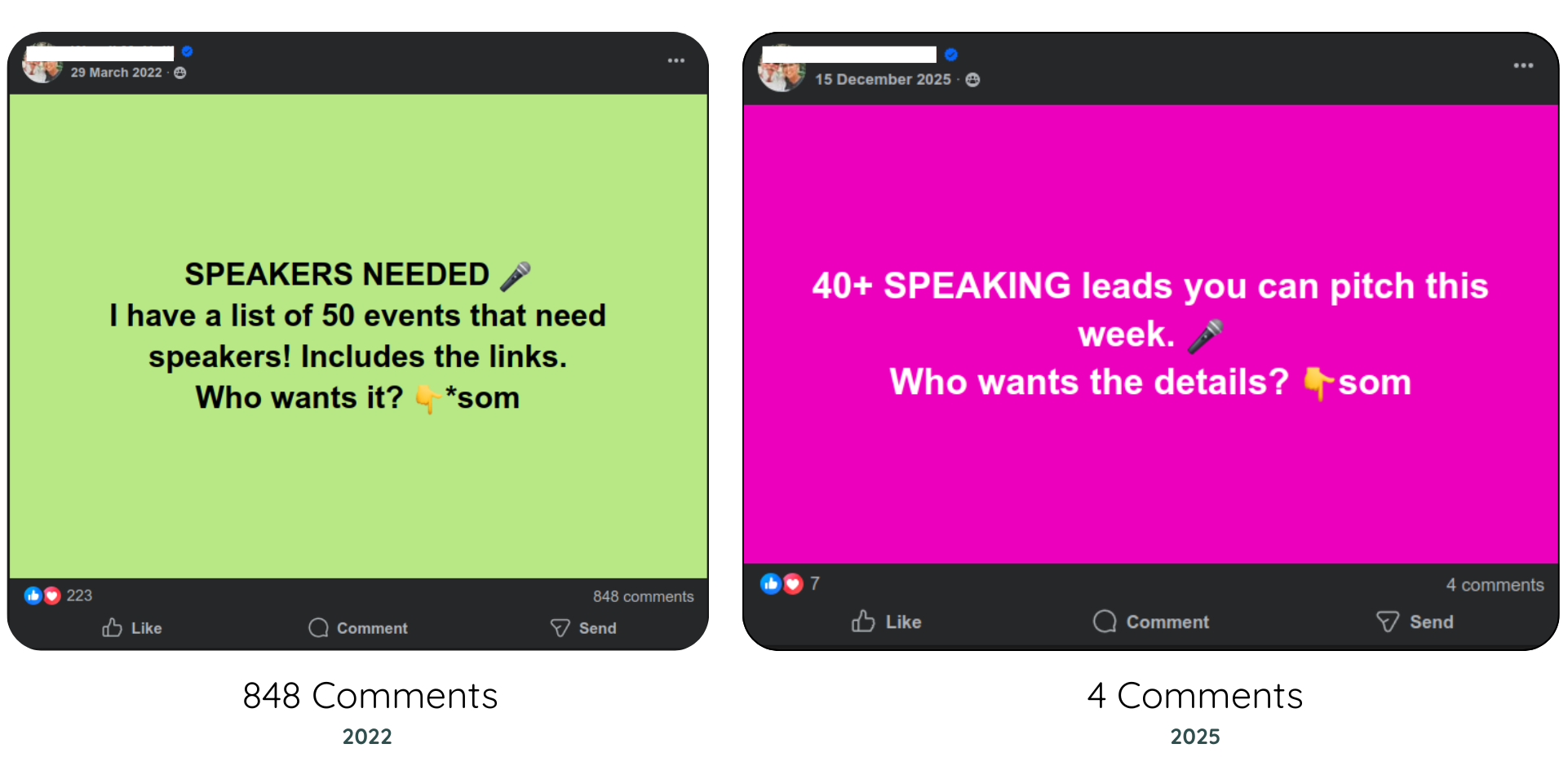
But here’s what nobody was mapping: the exact same pressure was showing up on the other side. Your clients.
They’re too overstimulated to book calls with strangers. They’ve learned that clicking through to a freebie means landing on a sales page and being upsold to — so they’ve stopped clicking. They’re more discerning than they’ve ever been, not because they stopped spending, but because they can’t afford to get it wrong. They have infinite options and limited bandwidth. They don’t want to be sold to. They want instant, low-friction clarity on whether you can actually solve their problem — yes or no — before they invest another second.
So here’s what it looks like from the outside:
Your calls aren’t booking because your clients are too distracted for calls.
Your freebie isn’t converting because your clients are weary of freebies.
Your ads aren’t landing because your clients don’t want to be sold to.
Your revenue is stalling because your clients want instant validation you’re not yet set up to give them fast enough.
Every symptom on your side has a mirror on their side. The forces making it harder for you to reach your clients are the exact same forces making it harder for your clients to find you. The disruption isn’t happening to one side of the transaction. It’s happening to both ends simultaneously.
The question is: what caused it? And why did it happen to everyone at the same time?
III. The Detective Work
When I started trying to understand what had changed in my own business, the first thing I did was track the timeline.
When did my own revenue start softening? Early to mid 2023. When did I first notice engagement dropping in Facebook groups — freebie posts getting less traction, comment counts falling? Beginning of 2023.
When did everyone suddenly start sounding polished and identical? Remember when everyone was unlocking, unleashing and elevating? Around 2023, peaking in 2024.
I started laying these dates next to each other and they all pointed to the same thing. One variable changed in that window. One thing entered the mainstream that hadn’t been there before.
ChatGPT rolled out to the public in late 2022.
Now, I want to be careful here. Because I know what you’re thinking. How can a productivity tool — a chatbot — cause an entire market to behave differently? Even experienced, well-intentioned professionals are operating at the wrong altitude.
I watched this happen explicitly in a public conversation with a credentialed marketing strategist. I raised the structural impact of AI on market dynamics — how it was reshaping buyer behaviour, supply conditions, trust signals. Her response:
“Get off the tangent of Ai because it has no validity in regards to branding outside of streamlining the client experience from the backseat of your business.”
Her logic was: this is just software. People use it for copy and automations. How is that doing this?
That was a good question. You might be wondering the same.
But what I kept noticing as I was watching this play out across thousands of businesses, was that the damage wasn’t random. It was hitting a specific layer — the people who trade in reasoning, synthesis, advice. The coaches. The consultants. The strategists. Not the people doing routine tasks, who were already being automated. And not yet the people doing physical work. The middle layer. The knowledge layer.
I couldn’t argue with what I was seeing. So I turned to the people who actually built this technology and who are currently working on understanding its implications — not the promoters, not the evangelists. The researchers. The people whose job it is to tell the truth about what this is.
And what they said was not what the marketing industry was saying.
Because while the marketing industry was debating funnel optimisation and branding semantics, the people who actually built and studied the technology were mapping the terrain.
AI researcher and ethics advocate Mo Gawdat talks about this disruption happening in three waves.
The first wave is what he calls the Mundane Wave. We’ve already been living through it. This is where AI takes over repetitive, rule-based work — things like customer service chats, basic writing and reports, scheduling, or data entry.
The second wave is the Knowledge Wave. This one hits traditional knowledge workers. Here, AI starts doing work that involves analysis, summarising information, and helping with decisions — the kind of tasks that used to rely heavily on human training and expertise.
The third wave is the Physical Wave. That’s when AI combines with robotics and autonomous systems and starts automating work in the physical world — things like logistics, manufacturing, construction, and service jobs.
That third wave is still on the way.
But the second wave is already here. We are inside it.
So the answer to “is it AI?” is yes. But that doesn’t yet tell us how, exactly. How does the release of a chatbot collapse trust signals across an entire market?
That requires understanding the mechanism. And the mechanism is not what you’d expect.IV. The Mechanism
This is the part that stings. But it’s also the part that makes recovery possible.
Think of AI’s effect on markets the way geologists think of erosion. Erosion doesn’t create weaknesses in rock. It finds them — the softer layers, the tiny fractures, the poorly bonded sediment. Over time, the landscape becomes a map of its own pre-existing vulnerabilities. What survives erosion had structural integrity from the start.
AI works the same way. It didn’t invent the vulnerabilities in your business. It removed the conditions that were masking them.
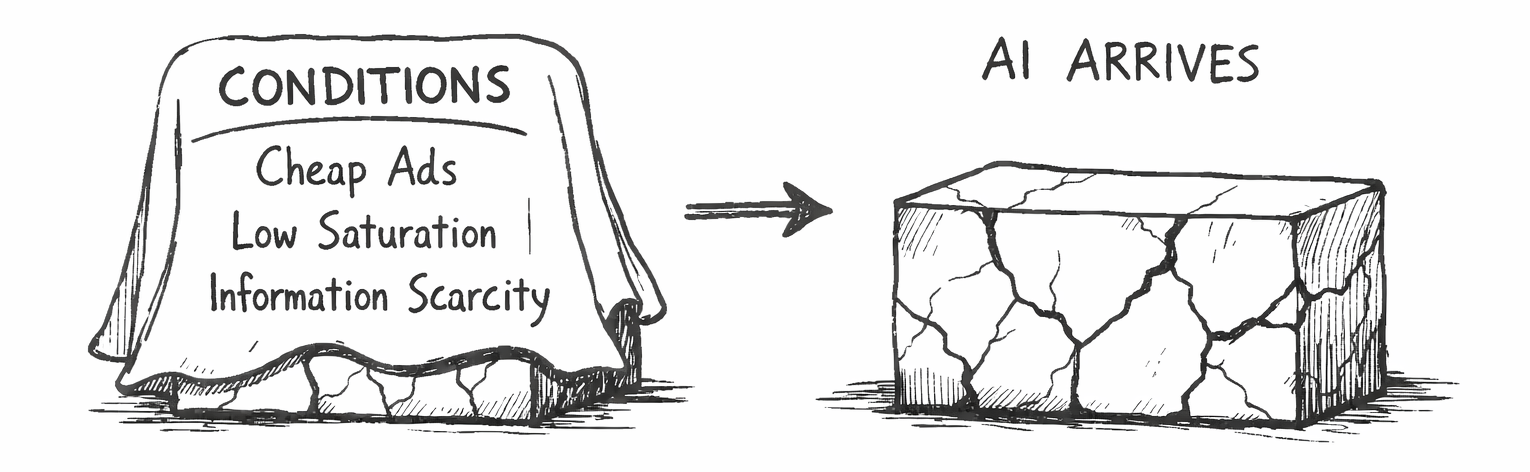
Here’s the thing about COVID that most of us don’t like to admit. The wave was real. The growth was real. The money was real. But for many of us, some of that growth was riding conditions, not foundations. Those conditions were a specific combination: cheap ads, low market saturation, and information scarcity. When all three were present, a business without deep positioning could thrive. The Covid era made this even more pronounced — demand surged, costs dropped, and the noise that now characterises the market simply didn’t exist yet.
My business went from a small home-based project in 2019 to a 7-figure company in 2021. It grew fast, it helped real people, and the results were genuine. The truth is that I felt it in my gut while it was happening. This growth feels wrong. I even said it out loud to my husband: I love it, but it feels too easy. I don’t know what’s right, but this doesn’t feel like it.
When that wave receded towards the end of 2022 — and when AI arrived simultaneously — what was left was a business that had never been properly tested against these new market conditions. Not exactly incompetent. But rather, contingent on conditions I could feel were temporary before I could prove they were.
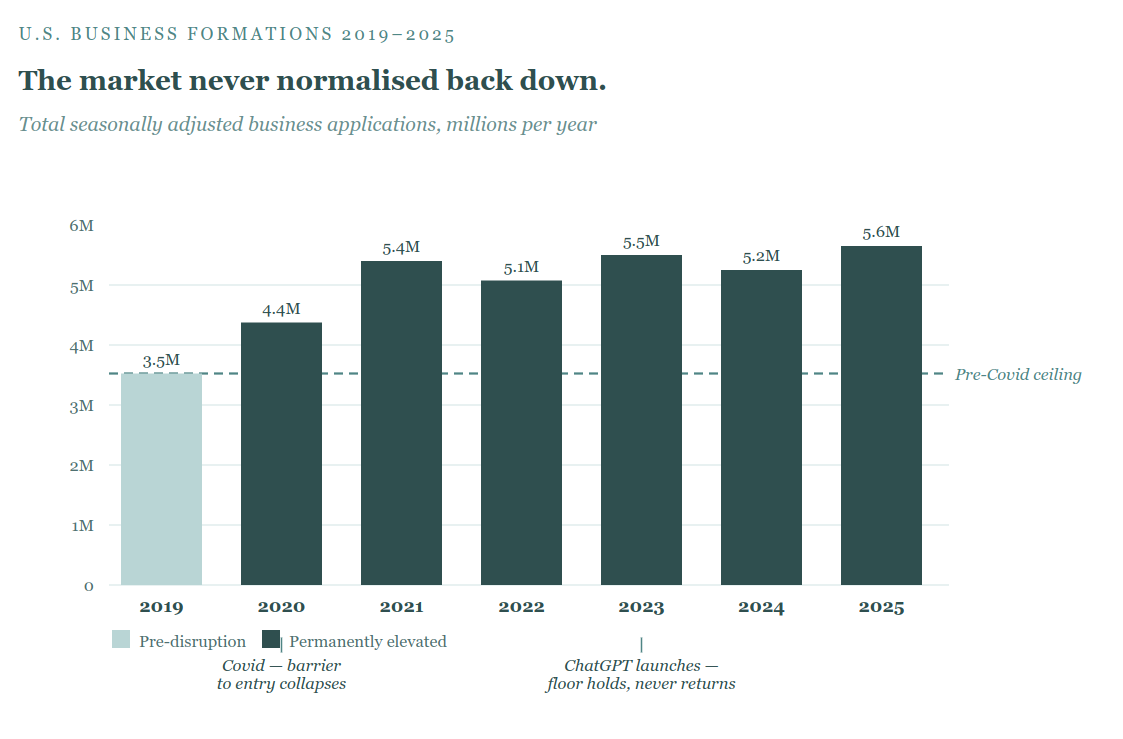
AI lowered the barrier to entry so far that 5.5 million new businesses entered the US market in a single year by 2023. Imagine every one of them using the same tools, producing the same content, making the same promises — and looking, from the outside, indistinguishable from each other. The signal-to-noise ratio collapsed. Your clients couldn’t tell the real experts from the noise. And because the noise was so voluminous and so consistent in its language, they stopped trusting the language altogether. So instead of leaning in, they hold back and silently wonder: What’s the catch?
Your credibility signals — the things that used to communicate trustworthiness — got cheapened. Frameworks became mass-produced by AI. Content flooded the information ecosystem. Testimonials got questioned. Confident language stopped being a differentiator because the charlatans had just as much of it, generated in seconds.
So what does that mean for your business? Specifically, concretely, for you?
V. The Reckoning
It means that the things you’ve been doing to fix it are almost certainly not addressing what’s actually broken.
Rewriting the copy is looking at the weather. Testing new ad creatives is looking at the weather. Tweaking the funnel, adjusting the price point, posting more consistently — all of it is looking at the weather. The weather is not the problem. The climate has changed.
You’ve been optimising inside a broken structure. That response is rational when you don’t have the framework to see what’s actually happening. You reach for the levers that have worked before. You hire the people who tell you the levers will work again. You try harder inside the same system because trying harder inside the system is what the system rewards.
But the system no longer produces the outcomes it once did because the underlying mechanism has shifted. The same levers now operate on something fundamentally different.
This is where it gets heavy, so I’m not going to soften it: the market is not going back to what it was. COVID didn’t go back. The post-COVID normal became the new normal — home delivery, online-first purchasing, digital everything — even when the pandemic itself ended. The change was structural and it was permanent.
AI is doing the same thing. This fog — this conversion collapse, this mirror of confusion between you and your clients — is not a wave that will break and recede. When AI adoption stops being the exciting new thing and becomes ambient infrastructure, it will not take the disruption with it. It will leave it. The landscape it’s exposing will stay exposed.
The businesses that are going to survive this are not the ones that wait for stabilisation. They are the ones that stop looking at the weather and start asking a different question entirely: what was always fragile here, and what genuinely survives?
That question is harder than it sounds. Because it requires you to look at what your business was actually built on — not what you believed it was built on, not what the good years confirmed, but what’s actually load-bearing when you take the favourable conditions away.
VI. The Fork
There are two things you can do with this.
The first is to go back to optimising. Better ads, cleaner funnels, a new offer, a new platform. Many people do this. It’s not irrational — you have evidence that things have worked before, and the tactical adjustments feel like progress. Some of them will produce short-term results.
But if the diagnosis in this essay is correct — and I believe it is, not because I’m certain about everything but because I’ve watched it operate across enough businesses to see the pattern — then optimising the funnel is rearranging the interior while the foundation settles.
The second is to start the structural work. To understand what in your business was always fragile, what genuinely survives, and what the next version of it actually looks like given the climate that’s now permanent.
This is the harder thing to do, because it’s to actually look at what you built. What’s actually there when you take the favourable conditions away and ask: does this still work?
Sometimes the answer is yes. The expertise is real, the differentiation is genuine, the value is the kind that erosion can’t reach — it just needs to be restructured, repositioned, made legible in a market that now requires more clarity than it used to. That work is hard but it’s doable.
Sometimes the answer is no. Or not yet. The foundation that would need to be there isn’t. And the most useful thing — the thing that saves the most time and money and emotional runway — is to know that clearly instead of finding out slowly.
Either way, the diagnosis comes first. Not a marketing audit. Not a messaging refresh. An honest structural assessment — where is this genuinely exposed, and where does it have real defensibility. The kind that doesn’t depend on external conditions staying in tact.
That question is what I’m now studying systematically. I’m researching 1,000 knowledge businesses — mapping what’s structurally present, what’s absent, and what the difference actually is at scale. The patterns are already telling. If you want to see what the data is finding, the research is here.